Life Science

Solaris Bioreactors & Fermenters

From Benchtop to Pilot Scale

BESCHREIBUNG

Solaris Biotech (Donaldson) provides a comprehensive range of modular fermenters and bioreactors for research, process development, and pilot-scale applications. The portfolio covers compact mini-bioreactors for early screening studies up to fully automated SIP pilot units up to 200 l.

As an official distribution partner, KREIENBAUM Neoscience GmbH supports you in selecting, configuring, and integrating the optimal bioreactor solution into your laboratory or production workflow.

Product overview

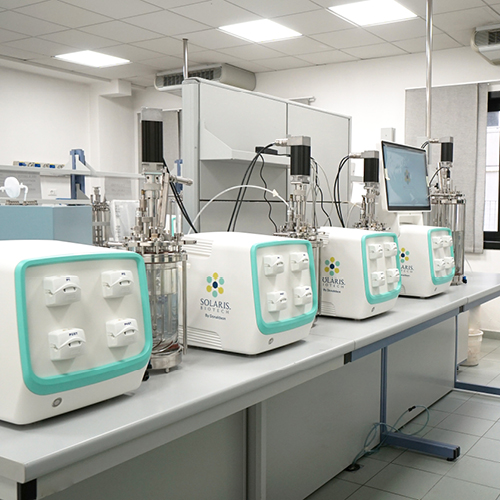
Solaris ONE –Benchtop bioreactor with Wi-Fi

Autoclavable 2 l benchtop bioreactor with Wi-Fi-enabled control software. ONE provides full automation of all critical process parameters (temperature, agitation, pH, DO, dosing) and is ideal for R&D, scale-up/scale-down studies, and parallel experiments.

Click here

Solaris IO – Electric mini-bioreactor

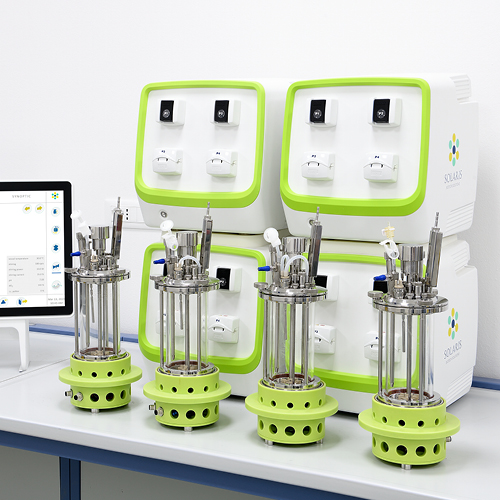
Compact electric mini-bioreactor available in 200 ml or 1 l versions. IO delivers fast and precise temperature control without a water loop, making it ideal for media screening, strain selection, and early process development.

Click here

Solaris JUPITER – Autoclavable benchtop system (2–10 l)

Modular and highly configurable autoclavable benchtop bioreactor with 2–10 l glass vessels. Supports batch, fed-batch and continuous processes. Optional pressure control up to approx. 1.6 bar, depending on vessel size.

Click here

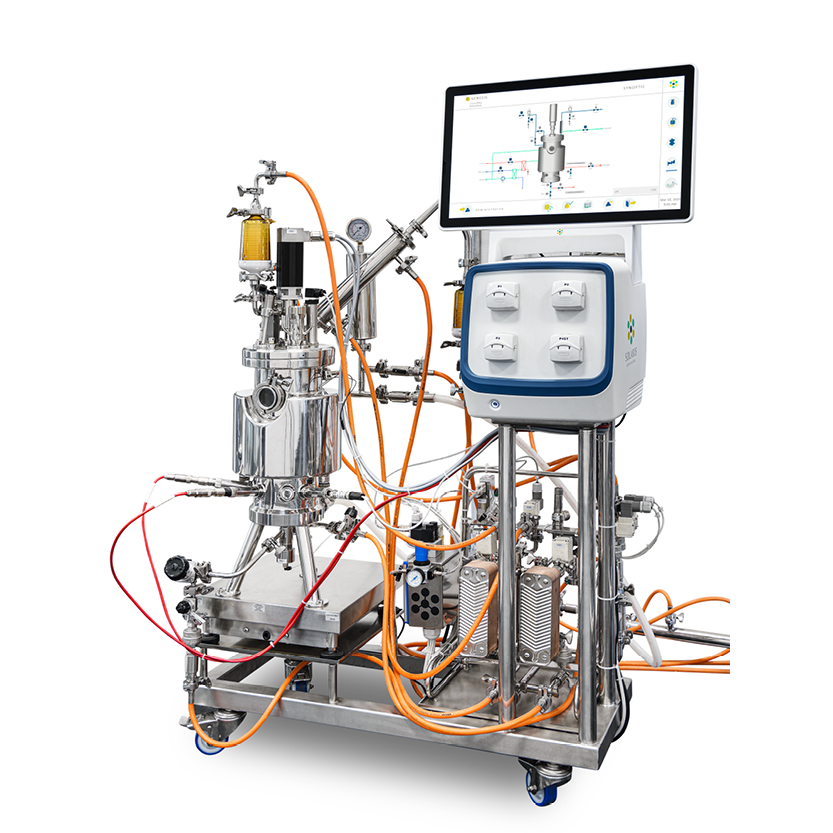
Solaris GENESIS – Benchtop SIP bioreactor (7.5–20 l)

Compact SIP benchtop bioreactor with automatic sterilization (steam, electric or hybrid) covering approx. 7.5–20 l working volumes. Ideal as a bridge between benchtop and pilot-scale applications for microbial or cell-culture processes.

Click here

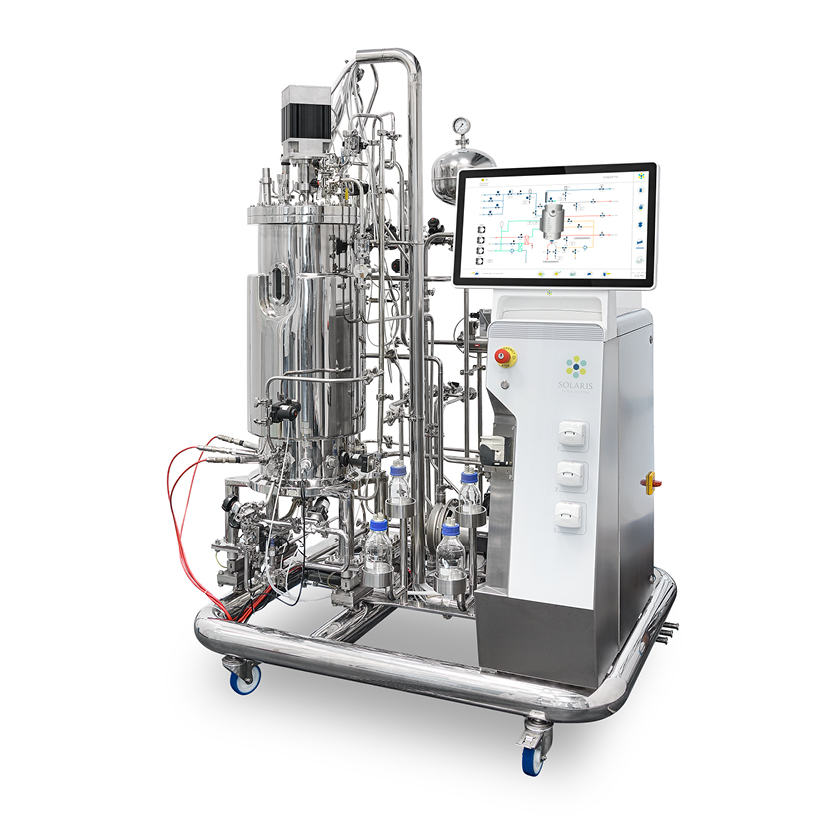
Solaris M-Series –Pilot-scale fermenters (30–200 l)

Pilot-scale SIP fermenters with 30–200 l working volumes. Designed for batch, fed-batch and continuous processes with interfaces for process control systems and data acquisition. Suitable for scale-up and pre-cGMP applications.

Click here

FAQ

Which Solaris fermenter or bioreactor is suitable for my application?

The choice primarily depends on the process objectives, organism, required working volume, sterilisation method and desired level of automation. 

  • ONE is a cost-effective, autoclavable 2-litre benchtop bioreactor that provides all essential basic functions for a budget-conscious entry into bioprocessing—ideal for universities and start-ups. 
  • With total volumes of 200 ml or 1 l, IO is particularly suitable for parallel screening, media optimisation and early-stage process development, and covers all standard functions. 
  • JUPITER is a highly configurable reactor with glass vessels ranging from 2 to 10 l in total volume, making it ideal for research, scale-up/scale-down and small-scale production runs. 
  • GENESIS also offers flexible configuration options and is a stainless-steel SIP system with total volumes ranging from 7.5 to 20 l. 
  • The M-series is available for larger pilot-scale processes, with total volumes ranging from 30 to 200l. 


Depending on their configuration, the systems can be used for both 

  • microbial fermentation and 
  • cell culture processes. 


Various impellers, spargers, gas delivery strategies and sensor options are available, including Rushton turbines, marine or pitched-blade impellers, and ring or microspargers. The specific configuration should be tailored to oxygen demand, shear sensitivity and process objectives. 

Yes. IO, ONE, JUPITER and GENESIS are designed for aerobic and anaerobic fermentation or cultivation, as well as closed aseptic processes. The gas supply and control strategy can be configured to suit the process. 

Typical basic parameters include 

  • temperature, 
  • agitation speed, 
  • pH and 
  • dissolved oxygen. 


Depending on the system and selected equipment, the following parameters can also be monitored or controlled: 

  • gas flow rate and gas composition, 
  • redox potential, 
  • conductivity, 
  • dissolved CO₂, 
  • cell density, 
  • weight, 
  • pressure, 
  • foam and liquid level. 


Not every option is included as standard on every platform. 

Depending on the platform, air, oxygen, nitrogen and carbon dioxide can be metered and mixed using thermal mass flow controllers. 

IO, JUPITER and GENESIS support configurations with up to five TMFCs in total. The number, measurement range and allocation to sparger or overlay gas delivery are selected to suit the application. 

Integrated or external peristaltic pumps can be used to add feed, acid, base and antifoam. Leonardo software can control the pumps based on time, process phase or measured values, and incorporate them into control cascades. 

Depending on the platform, sampling is performed manually or using sterile sampling solutions. For example, the optional LEDA system for JUPITER enables repeated sterile sampling throughout a batch. 

Yes. For benchtop systems, Leonardo software can manage up to 24 4 units via a shared human-machine interface (HMI). Parallel operation, parallel calibration, shared setpoint profiles and comparative trend displays support parallel screening, optimisation and scale-down studies.

Leonardo SCADA software displays process values in real time, manages workflows and control cascades, and enables visualisation of multiple variables and batches. 

Depending on the software version, data can be exported as CSV files and, in some cases, as PDF files. Remote access is available; additional features such as email notifications, 21 CFR Part 11 functionality, batch reports or external API connectivity are optional, depending on the version. 

As an official distribution partner of Solaris Biotech, KREIENBAUM Neoscience supports you in selecting, configuring and integrating the right solution. 

Additional services offered by KREIENBAUM Neoscience include installation, user training, maintenance and spare parts supply.

Interest

Sometimes text is not enough to describe what our products are …

beratung-img